

Imagine this-
You’re in the middle of nowhere, with only your wits to guide you. The sun’s beating down on your face, reminding you of how thirsty you are.
You can’t take a drink until you succeed in starting a fire, though. Otherwise, if you don’t boil your water, you might get sick.
In a state of nature, sickness could mean death…
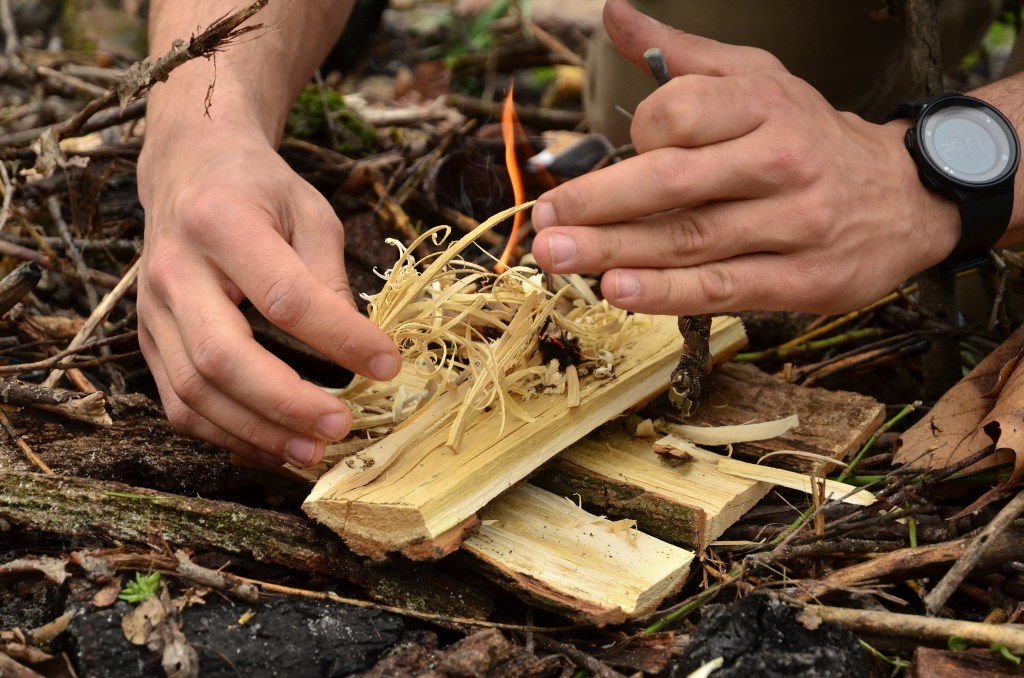
So, you decide that your first priority is to start rubbing a pair of sticks together. Hopefully, you’ll get a flame.
After an ungodly amount of time, though, the only thing you achieve is a pair of bloody palms. If you don’t get that fire started soon, you might die of thirst, or starvation, or cold…
You start to get nervous.
Indeed, in a state of nature, no fire could mean death.
Unfortunately, fire is just one aspect of what you’ll need to survive on your own.
You’ll also need to account for food and shelter. Companionship and defense… What if you get injured?
All of these things fall on you when survival’s on the line.
That’s why it’s hard to live in a state of nature. So hard, in fact, that you decide not to do it.
You pull the walkie-talkie out of your bag and make the call:
“It’s me… I’m officially tapping out.”
Now, anyone who’s seen the TV series “Alone” has a small sense of what it’s like to survive in the wilderness. It’s a challenge that few people can face and even fewer can overcome.
I’d even say that the only reason people go on the show is because their safety is ensured. Everyone knows they can push a button and be rescued by a team of trained professionals.
There’s comfort in the security of knowing they can return to society…
Here at the Dantian Project, though, we ask a simple question: What if there wasn’t a rescue button? What if society didn’t exist?
It’s a well-known thought-experiment that many philosophers have pondered over. What would life be like without any socio-political structures at all?
I invite you to imagine along with me:
You’re tired and dirty. And just as you take your first bite of a well-deserved meal, you spot something in the distance…
It’s another human!
The thought crosses your mind, “What if we work together? Surely, it’ll be easier for both of us to survive!”
But, then you notice that there’s not just one. In fact, there’s a whole group of them! Your heart skips a beat…
The savage looks on their faces tells you that they’re not interested in working together. Instead, they’re planning to kill you so they can take what you have.
That’s when you realize the ugliness of the situation: We’re all in competition with one another.
Not only do we need each other to share the daily workload, but we also need protection from outside groups. There’s strength in numbers.
See, in a state of nature, resources are finite. This truth has pitted mankind against each other from the dawn of time. Tribes have gone to war over resources just like they’ve banded together for mutual gain.
Because of that, the need for structure arises. It’s the hierarchy that allows groups of individuals to work together for a common cause. Without it, there would be no success.
Everyone needs to know who’s in charge, and where they fit in. We need to know the rules– when someone has broken them, and what the consequences are.
What happens if someone doesn’t do their job? How are interpersonal conflicts resolved? What happens if someone steals? Commits murder? Defects to another tribe?
Each of these can mean life or death.
Thus, such questions are only answerable within a clear system of governance. Whether it’s a tribal council, a dictator, king or a congress, judiciary and executive branch… There’s always a need for some type of government at all levels of human civilization.
Now, the only reason I’m bringing this up is because America has reached an inflection point.
Half the country believes that our government should be stripped away– back to bare bones. They want a system that comes as close to a “state of nature” as humanly possible.
Not an easy task with 350 million people to account for…
The other half wants to expand government by creating more social safety-net programs, some of which include universal healthcare and “education for all.” Again, these aren’t easy things for everyone to agree on.
In fact, the two sides couldn’t be farther apart…
My question to you is: Where’s the center?
America is predicated on the ideals of freedom and liberty. Well, in a pure state of nature, we start with absolute freedom and total liberty.
At the same time, we’re also responsible for every aspect of our own survival.
Fire maintenance, construction, food and water procurement, defense and medial care… All of it depends on one person: You.
When you team up with someone else, it’s true that they’ll help you carry the load. But, you must also relinquish some of your own personal freedoms in the process. It’s the only way to make a relationship work.
Yet, since we also want to preserve our freedom to express ourselves the way we want, there’s only so much we’re willing to give.
Of course, there are systems of government that step past this line on a regular basis. Take China for example…
There’s no freedom of speech there. No freedom to bear arms… Certainly no freedom to question the government…
Is it worth the sacrifice?
If it means the government can make snap decisions without worrying about violating human rights, does it, in a way, make sense?
Or does it go too far?
Is there a way to work together in large groups- even billions of people- and still preserve the core values that we hold dear in the United States?
I’m interested to hear your take on it! Feel free to leave a comment.





Leave a reply to Blake Gehbert Cancel reply